
 Instagram


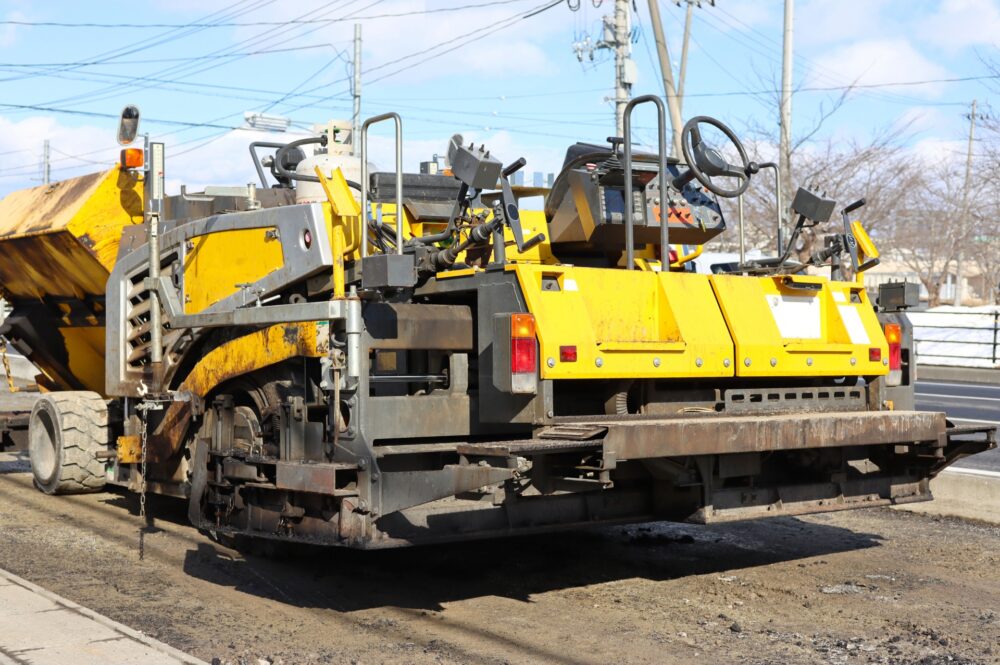
Are you looking to buy a used asphalt finisher (paver)? Even when the exterior looks clean, many machines have hidden problems.
This machine wears not from the outside, but in the “working parts” that are constantly exposed to the heat and friction of hot mix. If you end up with a unit whose screed or augers are worn, paving quality will be unstable, and whatever you thought you saved will disappear in repair costs.
Saijuki Engineering in Kumagaya, Saitama, Japan, specialists in heavy equipment repair and used equipment sales, explains how to tell a good used asphalt finisher from a bad one.
Contents
Narrow down candidates with numbers before seeing the machine
Inspecting a machine in person costs time and money. If you settle what you can judge from catalog specs and documents before you travel, you will avoid many wasted trips.
Check that hours and year of manufacture are consistent
Fewer hours are not always better. Machines that sat idle for a long time may have deteriorated seals, rubber parts and heater wiring. If a unit has extremely low hours for its age, ask why it was not used.
A machine that has been used in line with its age often has a clearer history and is easier to assess. That is our impression after years of looking at used machines.
Decide between crawler and wheel type first
Crawler types have a larger contact area and are stable on soft ground and slopes. However, they generally cannot travel on public roads, so plan to move them between sites by transport truck.
Wheel types can drive on public roads once registered. (In Japan, machines within 2.5 m width and under 15 km/h are classed as small special vehicles, and larger ones as large special vehicles; rules differ by country.) For companies that move between many small sites, this difference directly affects annual transport costs.
Does the paving width suit your job sites?
Asphalt finishers come in series by paving width. Taking Sumitomo as an example, there are mini classes of 0.8–2.5 m, classes of 2.0–4.5 m, and classes of 2.3–6.0 m; the extendable width and machine size change accordingly.
A company that mainly paves residential roads and parking lots will find a large machine too much, while a machine that is too narrow creates more joints. We cover the strengths of each manufacturer in a separate article.
Check the screed, the heart of the machine
If the screed, the heart of the asphalt finisher, is in poor condition, the paving finish will be uneven.
The screed spreads and compacts the mix, and its precision shows directly on the road surface. Repair costs also tend to be higher than for other parts, so check it first.
Wear of the screed plates
Check that the screed plates, which touch the asphalt directly, are not excessively or unevenly worn.
What matters is not how much they are worn but how they are worn. Uneven wear, such as different thickness left and right or rounded edges on one side only, may be caused by misaligned screed mounting or leveling. Replacing only the plates will lead to the same wear again, so the cause must be checked.
If the wear is clearly noticeable as a step when you run your palm over it, it is safer to assume replacement.
Heater ignition and heating
Check that the heaters, which prevent asphalt from cooling and sticking, ignite and heat up smoothly.
What you want to confirm is not “whether it turns on” but “whether the full width heats evenly.” If one side does not heat up, the cause may be wiring, relays or temperature sensors rather than the heater itself. Where to check also differs between electric and gas heaters, so always ask which type it is.
Play in the extending screed
If the screed is extendable, ask for it to be operated both retracted and extended. Play in the sliding parts shows up as steps in the paved surface when extended. Stiff movement or catching partway through signals wear of the sliding surfaces or deterioration on the hydraulic side.
Augers and conveyors: the front line of wear
These parts rotate and drive intensely in direct contact with asphalt, so they wear very easily.
Auger (screw flight) wear
First, check that the flights still have sufficient thickness.
Rounded edges, thinning or chipping are signs that replacement is needed.
When the flight diameter wears down, mix delivery drops and the head of material in front of the screed becomes inconsistent. If that head fluctuates, the finished thickness fluctuates too. If wear differs between left and right, suspect the sensors that control the feed rate rather than the flights themselves.
Conveyor chain tension and bar deformation
Check the tension of the conveyor chains that carry the asphalt mix.
They should be neither too loose nor too tight.
Also check the bars for deformation.
It is also worth checking how much adjustment is left in the adjusters. If the chains are fully stretched with no adjustment left, you will need to replace them soon after purchase.
Wear parts are a bargaining point
The screed plates, augers and chains mentioned above are consumables that will eventually need replacing. Wear alone is not a reason not to buy. Estimate the cost of replacement and ask for it to be reflected in the price. We believe this is the realistic way to buy a used machine.
Customers sometimes ask us, about a unit they found at another dealer, “how much would replacement cost in this condition?” If you are unsure, send us photos and we can give you a rough estimate.
The hopper reveals the previous owner’s maintenance habits
One look at the hopper at the front, which receives the asphalt mix, tells you how well the machine was maintained day to day.
A used asphalt finisher with a clean hopper has usually been well cared for, so it is often a good unit.
Hardened asphalt build-up
It may seem minor, but if old asphalt has hardened inside the hopper or wings, cleaning and maintenance have likely been neglected, which raises the chance that other parts were also poorly maintained.
If the machine is cleaned after every job, build-up does not form. In other words, build-up means daily cleaning was skipped.
Deformation and holes
Check for heavy dents from contact when receiving mix from dump trucks, and for holes in the steel plate due to wear.
If the hopper floor plate has thinned, it gradually deforms under the weight of the mix. If there are signs of welded patch plates, check the surrounding area as well.
Wing cylinder oil leaks
Not only here, but check for oil leaks from the cylinder seals on the hopper wing mechanism.
Even for the same oil leak, the cost differs by an order of magnitude depending on whether a seal replacement fixes it or the rod is scratched and needs polishing or replacement. Ask for the rod to be extended and check its surface for vertical scratches. Even in our own repair work this is a judgment call, and honestly it is difficult to determine from photos alone.
How to request photos and videos when you cannot see the machine in person
Inspecting on site is best, but a good unit will not always be available in your area. In that case, you will need to ask for multiple photos and videos of the areas you are concerned about.
However, if you simply ask for “photos,” you usually receive only a few overall exterior shots. Specify as follows and you will get material you can actually use to judge.
・Screed plates from the side, left and right ends separately
・Full width of the screed 10 minutes after turning on the heaters
・Video of the augers running (with sound)
・One shot looking down into the hopper from above
・Hour meter and nameplate (model and serial number)
For video, it is especially effective to ask for three uncut minutes from the moment the engine starts. White smoke, abnormal noises and warning lights appear in the first few minutes after starting and disappear once the engine warms up. This reveals what an edited video cannot.
Frequently asked questions
How much does a used asphalt finisher cost?
New machine prices vary greatly with paving width. As a rough guide in Japan: around JPY 10 million for mini classes with about 1.4 m paving width, around JPY 30 million for 2–4.5 m classes, and JPY 60–80 million for 6 m classes. Used prices depend on year, hours and screed width; older small machines can be found for a few million yen, but mid-size and larger machines over JPY 10 million are not unusual. Since post-purchase costs depend on how much life is left in the wear parts, we recommend not comparing on the machine price alone.
Is a license required to operate one?
The following applies to Japan. It may be surprising, but asphalt finishers are not included in the “vehicle-type construction machinery” listed in Appended Table 7 of the Order for Enforcement of the Industrial Safety and Health Act, so operator skill training is not uniformly required by law. In practice, however, main contractors often require completion of vehicle-type construction machinery skill training as a site entry condition. To drive on public roads, a small or large special vehicle license is required depending on dimensions and top speed. Requirements vary by site and by country, so please check with the main contractor or local authorities.
Should I choose a crawler or wheel type?
It depends on ground conditions and how often you move. If you work mostly on soft ground or slopes, choose a crawler type; if you move between many small sites, a wheel type is easier to handle. Whether you own a transport truck is also a factor.
Can I put it to work right after buying?
The scope of pre-delivery servicing varies greatly by dealer. Some keep machines as-is until an order comes in and service them at delivery; others sell as-is. Confirm in writing before signing how much servicing will be done.
Summary
Strictly speaking there are many more points to check beyond those listed above, but start by checking at least these areas.
Comparing several units will help you find a better used asphalt finisher.
As you compare, you will realize that a clean exterior does not always mean good internal condition.
Also, some used equipment dealers keep machines as-is until an order comes in and fully service them before delivery, so it is safer to confirm the delivery conditions.
At Saijuki Engineering, we regularly receive used asphalt finishers in good condition.
If you are looking for a particular unit, please feel free to contact us.
Because repair is our core business, we identify what needs fixing at the time of arrival before handing machines over. Even if the unit you are considering is from another dealer, we are happy to advise on how to assess its condition. We ship from Kumagaya, Saitama to buyers throughout Japan and overseas.